FCAPS
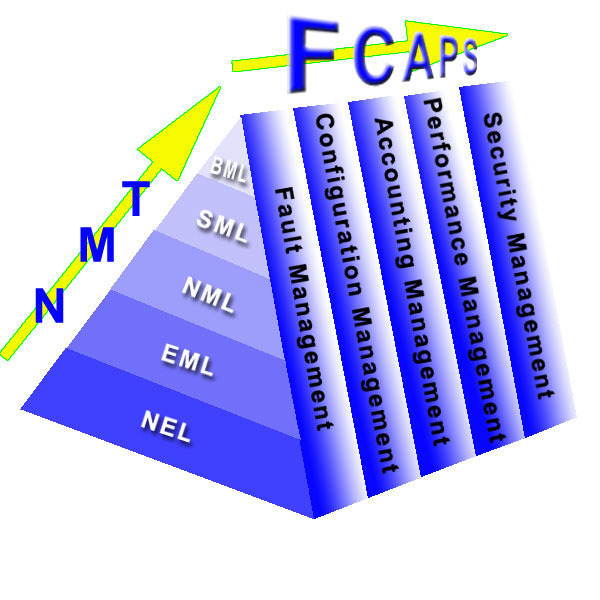
FCAPS is an ITU standard model for enterprise management.
The five FCAPS domains are:
- Fault Management
- Configuration Management
- Accounting Management
- Performance Management
- Security Management
Fault Management
Fault management is the domain where network problems are discovered and corrected. Steps are then taken to prevent them from occurring or recurring. By doing so, the network remains operational and downtime is minimized.
Configuration Management
Configuration management is where daily operations are monitored and controlled. All hardware and programming changes are coordinated. In addition, new programs, new equipment, modification of existing systems and the removal of obsolete systems and programs are also coordinated.
Accounting Management
Accounting management is devoted to determining how to optimally distribute resources among enterprise subscribers. This helps to minimize the cost of operations by making the most effective use of the systems available. This level is also responsible for ensuring the appropriate billing of users.
Performance Management
Performance management is involved in managing the overall performance of the enterprise network. Potential problems are identified, throughput is maximized and bottlenecks are identified. Improvements that will yield the greatest enhancement to overall performance are identified.
Security Management
Security management is responsible for protecting the network from unauthorized users and physical and electronic sabotage. Security management is responsible for user authentication and authorization. It also maintains the confidentiality of user information.
- SNMP (Simple Network Management Protocol)
Network management systems use SNMP (Simple Network Management Protocol) to communicate with network elements. For this to work, the network element must be equipped with an SNMP agent. Most professional grade network hardware comes with an SNMP agent built in. These agents must be enabled and configured to communicate with the network management system. Operating [...]...
- Reverse DNS
Reverse DNS is the process of using DNS to translate IP addresses to hostnames. It is the opposite of forward DNS, which is used to translate hostnames to IP addresses. Internet names are those used to refer to hosts on the Internet, such as www.tech-faq.com and www.freebsd.org. IP addresses are the numbers that Internet routers [...]...
- Information Lifecycle Management (ILM)
Information Lifecycle Management (ILM) is a process for maintaining information storage at the least possible cost, while concurrently maintaining appropriate levels of availability. The first phase in the Information Lifecycle Management process is to determine what information is being stored and how it is being accessed. The two steps in this phase are the Data [...]...
- LUN Masking
LUN (Logical Unit Number) Masking is an authorization process that makes a LUN available to some hosts and unavailable to other hosts. LUN Masking is implemented primarily at the HBA (Host Bus Adapter) level. LUN Masking implemented at this level is vulnerable to any attack that compromises the HBA. Some storage controllers also support LUN [...]...
- Service Management
Service management, also called IT service management, is the discipline used in industries that provide services or a combination of goods and services. While widely used in the IT industry, specifically the ICT (information and Communication Technology) sector, service management can be integrated into many other industries. Service management is usually used in conjunction with [...]...