

Code Division Multiple Access (CDMA) is a channel transmission standard that allows several transmitters to send information simultaneously over a single communication channel. This ensures that the available bandwidth is used in an optimized manner. It is a form of multiplexing and is used for wireless communication.
Radio communication makes use of two resources: frequency and time. If individual frequencies are allocated part of the spectrum all within the band all of the time, the result is Frequency Division Multiple Access (FDMA). If the same frequency channel is shared by dividing the signal into different time slots, the result is Time Division Multiple Access (TDMA). FDMA therefore allows for division by frequency and TDMA allows for division by time. CDMA on the other hand allows each frequency to be allocated the entire spectrum all of the time. This process is known as multiplexing and allows several users to share a certain amount of bandwidth. Every channel therefore makes use of the full available spectrum.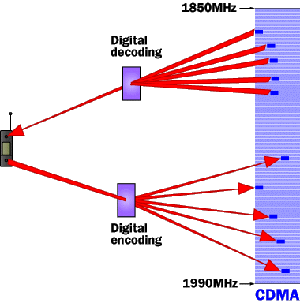
CDMA works by assigning unique spreading codes before data transmission. Several codes can occupy the same channel which is below noise level. The signal is then transmitted through this channel and the receiver uses a correlator to despread the signal through a filter. Codes are sent in one – zero formats and run at a faster rate than the data being transmitted. The rate of a spreading code is known as chip rate. The codes themselves are basically used to provide uniqueness to data identification. There are two basic types of CDMA; Direct-sequence Code Division Multiple Access (DS-CDMA) and Frequency Hoping Code Division Multiple Access (FH-CDMA). DS-CDMA spreads the signal directly by multiplying the data wave with a unique bandwidth and then mixing up to a carrier frequency before transmitting it. The receiver mixes down to baseband then re-multiplies it with the unique bandwidth. A filter is then used. In contrast, FH-CDMA allows for a large chunk of the bandwidth to many possible broadcast frequencies by changing the carrier frequency against a certain hopping pattern. The signal therefore sees a different channel and a different set of interfering signals during each hop thus avoiding failed communication at a particular frequency due to a fade or a particular interferer. In general, frequency-hopping devices use less power and are cheaper, but the performance of DS-CDMA systems is usually better and more reliable.
Other CDMA schemes include Multi-carrier Code Division Multiple Access (MC – CDMA) and Ultra Wide band (UWB). MC-CDMA uses multi-carrier transmission of DS-CDMA. However, its spreading is applied in the frequency domain rather than in the time domain as in Direct Sequence CDMA.
CDMA was first used during World War II by English allies to foil German attempts at jamming transmissions by transmitting over several frequencies making it impossible for the Germans to pick out a complete signal.
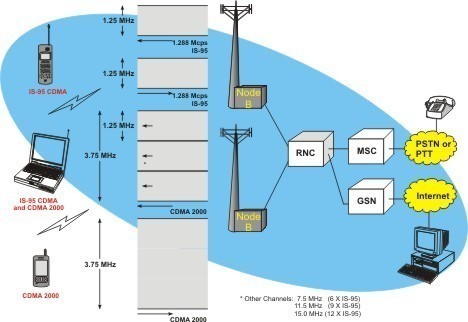
CDMA has different standards. CDMA One offers a transmission speed of up to 14.4 Kbps in its single channel form and up to 115 Kbps in an eight-channel form. Other CDMA standards including CDMA 2000 and wideband CDMA offer much faster data transmission.
kaiser
this is very reliable information about cdma