

The word forensic comes from the Latin word forensis, which means “before the forum,” and refers to something “of, pertaining to, or used in a court of law.” In this day and age, it almost always refers to a method of obtaining criminal evidence in order to use it in a court of law.
Forensic science is typically just referred to as “forensics” and is the practical application of numerous sciences to solve legal system related questions in either a civil or criminal action.
Using the term “forensics” in place of “forensic science” is actually a globally accepted misnomer considering that the term “forensic” is effectually a synonym for “legal” or “pertaining to courts,” from the root Latin meaning.
Because it is now so closely associated with the criminal scientific field, many dictionaries equate the word “forensics” with “forensic science.”
Forensic science extends into a broad range of sub-sciences that utilize natural science techniques to obtain relevant criminal and legal evidence.
Forensic science specialties include:
- Forensic Accounting – The acquisition, interpretation, and study of accounting evidence.
- Digital Forensics (also known as Computing Forensics) – The retrieval, reconstruction, and interpretation of digital media (images, PDFs, e-mail messages, etc.) stored on a computer for use as evidence.
- Forensic Document Examination – The reconstruction, study, and interpretation of physical document related evidence, such as handwriting analysis and printmaking.
- Forensic Economics – The acquisition, study, and interpretation of evidence related to economic damage, which includes determination of lost benefits and earnings, business value and profit loss, lost household service value, labor replacement, future medical expense costs, etc.
- Forensic Engineering – The reconstruction, study, and interpretation of structural or mechanical failure in devices, buildings, etc.
- Forensic Linguistics – The study and interpretation of language for legal evidence use.
- Forensic Origin and Cause- The study, interpretation, and identification of a fire for the express purpose of determining the cause of ignition and origin of the fire (arson cases).
- Forensic Photography – The art-science of reconstructing, interpreting, and producing an accurate photographic reproduction of a crime scene for a court’s benefit.
- Forensic Psychology and Psychiatry – The study, evaluation, and identification of mental illnesses and human behavior for the purpose of obtaining legal evidence.
- Forensic Anthropology is the practice of physical anthropology as applied to a legal situation; typically the identification and recovery of human skeletal remains (bones).
- Criminalistics is the application of impression evidence (fingerprints, footwear, and tire track impressions), trace evidence, and controlled substances. It includes evidence collected from a wide range of sciences to determine the answers to questions relating to the examination and comparison of criminal investigations. This evidence is typically processed in a crime lab.
- Forensic Biology includes performing DNA and serological analysis of bodily fluids for identification purposes.
- Forensic Entomology assists in determining the time and location of death by examining how insects relate to human remains. This can often times determine if the body being examined was moved after death.
- Forensic Geology is the application of trace evidence found in soils, minerals, and petroleum.
- Forensic Meteorology is an analysis of prior weather conditions specific to the site being examined.
- Forensic Odontology is the study of teeth, specifically the uniqueness of dentition.
- Forensic Pathology combines the disciplines of medicine and pathology to determine cause of injury or death.
- Forensic Toxicology is the study, evaluation, and identification of the effects of poisons, chemicals, or drugs on the human body.
Crime Scene Investigation as Related to Forensic Science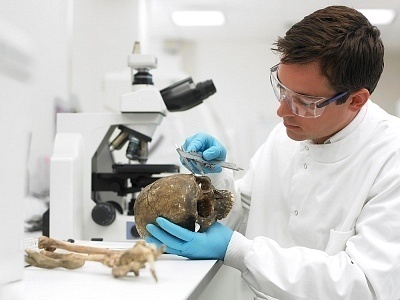
Crime Scene Investigation is directly related to forensic science, though not quite the same (CSI).
A Crime Scene Investigator’s primary function is to collect, identify, document, and preserve physical evidence left at the scene of a crime, with the ultimate goal of presenting a court with evidence to identify and apprehend the perpetrator.
CSI combines the knowledge and techniques of several different disciplines. These include science, mathematics, logic, and law.
This highly advanced branch of forensic science utilizes a combination of the scientific method and deductive reasoning to discover and document physical evidence at a crime scene. This is done in order to construct a re-enactment of the crime as applied to law enforcement and the legal system.
The primary difference between CSI and forensics is that CSI involves on site investigation (field forensics) of the physical scene of a crime, whereas standard forensics takes place in a controlled environment (lab).
Though it is not necessary for a CSI to be a forensic scientist, it is certainly advantageous for the CSI to understand how evidence collected is analyzed in a lab. Other titles that describe this job function includes:
- Crime Scene Technician
- Crime Scene Analyst
- Evidence Technician
- Forensic Investigator
Brief History of Forensic Science
Forensic science dates as far back as 212 BC. The earliest account of using fingerprints for establishing identity dates as far back as the 7th century.
During the Roman Empire, someone charged with a crime had to publicly plead their case before a group of their peers.
Both the accuser and the accused would give his/her side of the story. The individual with the best debate (argumentation and delivery) skills would determine the case’s outcome.
The person with the best forensic skills won, much like lawyers do today.
The first written account of combining entomology and medicine for acquiring and analyzing evidence to solve criminal cases can be found in a 1248 Chinese book that Song Ci wrote, which translates to “Collected Cases of Injustice Rectified.”
In one account, the case of a sickle murder was solved by a forensic science investigator who instructed everyone to bring their sickles to a specific location. Flies gathered on the sickle with the blood, and the killer ultimately confessed and was brought to justice.

Nagendrakumar Namagiri
I want to know more about forensic sciences
Dr. Khan
Hi,
I am pharmacist( Pharm.D) and i am so much intrested in Forensic Science. Can u tell me something about Forensic Medicine?
justice
I am still curious about which branch of forensic science actually goes to the crimes scene and collects evidence. the internet has only produced conflicting results and I am interested in possibly persuing this as a career. What is the title of the position and does it have other names?
Jamiss
I am currently going to school to get my masters degree in science to become a forensic scientist and it is a lot harder than you all think its not really anything like any of those stupid shows its real life so if that is the only reason you want to pursue this career is because you like csi then your in for a huge surprise
pradeep singh
im very interested in forensic science n it very good web for me
cody
this is an epic career!!!
Marikia Mathews
I am very interested in Forensic Science!!!!!!!!!!!!!!!!
EDD
ws interested in doing this but i figure that it i go to schooling to be a vet tech i can still learn some of the sciences that i like. I hear it can be fun to be a vet tech u get to be like and intern at a hospital!
anna falipowitz
What are some good colleges to go to for forensic science? I”ve always wanted to pursue a degree in this field. i am 15 and already wondering about college. Expecially pathology. If you know please answer back thanks!
HILDAH TOO
I HAVE DONE CRIMINOLOGY AND SECURITY STUDIES IN THE UNNIVERSITY AND MAJORED IN FORENSIC INVESTIGATIONS.I STILL WANT TO PERSUE MORE ON FORENSICS BUT ITS NOT REALLY AVAILABLE IN MY COUNTRY.HOW CAN YOU ASSIST ME?
memenode
We can only offer information like the article provided above. You can continue studying on your own. Just do more research, perhaps try to get a job or internship at a local investigations office. Perhaps you could even open up shop to offer services privately? I’m not sure, I’m not an expert.
Last resort is always to travel elsewhere for more opportunities.
i
ok um hi, this article really helped me understand a little more about what I want to pursue someday. So far I would like to deal with either of theses three catagories Anthropology, Biology, or Etomology Forensics. I have wanted to do this for a long time. 😉
Not Telling You
I used this site for a science fair project. I’m not a weirdo. I just have always been told to never give out personal info. (hints: the name) I love the forensic science topic though. This is an awsome article too. It has plenty of info. 😆
malak
i am 😉 16 years old and also interested in forensic science i watch csi miami and los angelos and new york and im inspired in all of that im a female andi think its wierd for a female to be likin
g tht but i was my interested since i was a kid
cody
im 17. and freaking love C.S.I 😀
alutha mnqokoyi
😀 i am a 16 year old who is highly interested in forensic science and pathology, for me being part of a team of people who dedicate their lives to solving mysteries of improving ways to solve them has always been my interest… its great to see articles like these that explain the career to me as a whole… its a great way to gain information about this particular career i am interested in.. this article is a great way for me to learn more about my career, without having to watch NCIS or CSI:maimi 😉
mpho nare
it is a great article thank you