

An EMF meter detects and measures an electromagnetic field. There are many types of EMF meters and they have many uses, including ghost hunting. Most EMF meters are “AC EMF meters” and can only detect the rate of change in an oscillating magnetic field. However, commercial grade EMF meters that can detect specific electromagnetic frequency ranges are available. While any EMF meter is generally capable of taking accurate measurements of most electromagnetic fields, the user should do research before purchasing an EMF meter for any specific project, experiment, or task.
How an EMF Meter Works
In a basic EMF meter, a coil is connected to an amplifier that is connected to an inverter and a gauge. When an electromagnetic field is present, it induces a small voltage in the coil. This voltage is then amplified several thousand times in order to give a measurement that can actually be represented in terms that average people can understand. The voltage is then passed along to an inverter that converts the AC (Alternating Current) electricity into DC (Direct Current) electricity. The DC voltage is then relayed to a gauge that displays the measurement in Volts, Hertz, Teslas, etc.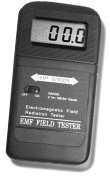
Applications
EMF meters commonly detect microwave oven leaks and radio frequencies, and measure electrical appliances’ output levels. They are also used to research ghosts and other paranormal phenomena as it is believed that these paranormal entities radiate their own electromagnetic field and can cause disturbances when in the presence of other electromagnetic fields, such as those being emitted from power lines, households, and large electrical appliances.
Advantages
An EMF meter is very easy to use when an experienced user handles it, and it poses no risk to the user or nearby appliances. EMF meters are compact and can fit into most travel bags, toolboxes, and other storage containers. There are many types of EMF meters available and they can be calibrated to measure specific frequency ranges, making them ideal for situations that call for precise measurement. Also, EMF meters only measure alternating current, which is usually emitted from man-made appliances. Direct current, which the Earth’s geometric field naturally produces, does not confuse alternating current.
Disadvantages
Although many EMF meter types exist, the most sensitive models can be quite expensive. Also, single-axis EMF meters must be tilted and rotated on three different sides to measure all three dimensions of an electromagnetic field. Tri-axis EMF meters can measure all three dimensions of an electromagnetic field, but they are more expensive than single-axis models.

Follow Us!