

A multimeter combines several electrical meters into one hand-held unit. Basic multimeter models measure voltage, current, and resistance. Advanced models also measure temperature, inductance, capacitance, duty cycle, and frequency. They can also test diodes and transistors. Some even work as an oscilloscope. The two main types of multimeters are digital and analogue.
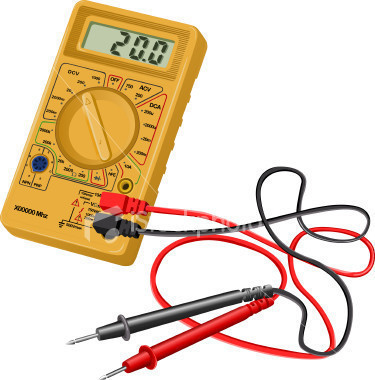
Parts of a Multimeter
A multimeter has a display, terminals, probes, and a dial to select various measurement ranges. A digital multimeter has a numeric digital display, while an analog has a dial display. Inside a multimeter, the terminals are connected to different resistors depending on the range selected. Ideally, a voltmeter should have infinite resistance so that no current flows through it and an ammeter should have zero resistance so that maximum current flows through it. However, there will always be some inaccuracy due to resistance.
Digital vs. Analog
A digital multimeter is more accurate and precise than an analog one. In an analog multimeter, the user is required to judge the needle’s position on the dial and set the needle to the zero position. This leads to parallax errors, which a digital multimeter does not have since its display is numeric. Many digital multimeters are auto ranging, which means that the appropriate measurement range is selected automatically. This can reduce errors that reading a value with the wrong range set causes.
Probes
Multimeters come with a positive (red-colored) probe and a negative (black-colored) probe. They can only read electrical signals. Hence, other signals are converted to electrical signals via a transducer probe. There are other probes available to measure temperature, wind speed, light, and pH. A clamp meter probe fits over a cable to measure its current flow and some multimeters even have a built-in clamp.
Safety
Multimeters have four safety ratings (CAT-1 to CAT-4). It is important that voltage and current levels do not exceed the specified maximum level. Overloading can destroy the meter and is potentially fatal. The basic cheap multimeters that are CAT-1 should not be used for testing a main’s power. Always check the insulation around the probes and wires for any breaks before using the multimeter. Never measure voltage on a current based setting because the low resistance will act as a short if the fuse does not blow first.
Troubleshooting
- Check the internal battery, it should not be flat. Make sure that the internal fuse is not blown.
- Check the probes to see whether they are in their correct socket and their polarity has been reversed.
- Check that the dial setting is correct, since one common mistake people make is that they try to read AC voltage on a DC range.

Follow Us!