

Variac is the trademark name of a variable autotransformer. A variable autotransformer is a single-coil transformer in which two portions of the same coil are used as the primary and the secondary. Variable autotransformers are used for the same purposes as regular transformers, but handle lower voltages. They also differ from regular autotransformers in that they are equipped with automatic switchgear in order to automatically step a voltage up or down, depending on preset conditions.
How Variacs Work
Variable autotransformers consist of a regular autotransformer that has been scratched in order to expose part of the coil, a sliding brush, and any automatic switches that a particular Variac requires. In the autotransformer, a primary voltage is connected from the bottom to a specific winding known as a “tap,” and a secondary voltage is connected from the bottom to a separate winding. Each winding or tap represents a different voltage. As voltages travel through the coil from both the primary and the secondary, the overall voltage is increased or decreased, depending on the placement of the primary and the secondary voltages and the number of taps in between them. In a variable autotransformer, the secondary voltage is applied to the exposed portion of the autotransformer via a conductive sliding brush.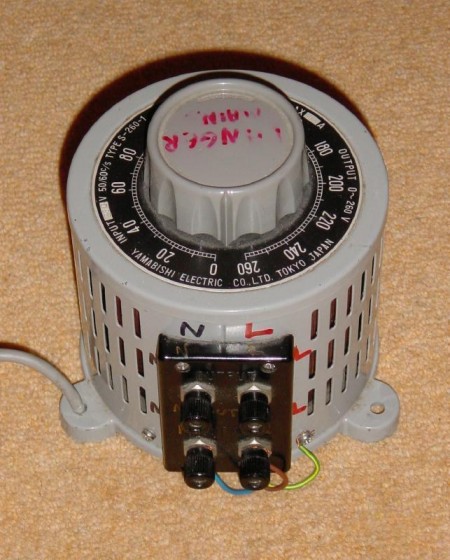
Applications
Variable autotransformers automatically regulate voltages for industrial equipment, simulate power line conditions, and control switches that are dependent on external events. Variable autotransformers are also used as automatic alternatives to regular autotransformers, which can be used in any situation that a regular transformer can be. They are lighter, less expensive, and handle lower voltages, generally ranging between 110 V and 240 V.
Advantages and Disadvantages
Variable autotransformers have several important advantages that other transformers, including regular transformers and autotransformers, do not. For example, variable autotransformers require less windings and a smaller core than a regular transformer, allowing them to be used in smaller applications. Also, variable autotransformers can be automated, allowing them to quickly change between voltage ratios. However, variable autotransformers do not provide the electrical insulation between their windings like regular transformers do. This presents a safety hazard as it possibly allows a high primary’s full input voltage to pass directly to a low secondary’s output.
Follow Us!