

A pneumatic actuator is a device that is capable of converting energy from a pressurized gas into motion. There are several different types of pneumatic actuators and each of them are designed in a slightly different way. Pneumatic actuators can be used to produce both rotary and linear motion and are usually powered by an electric compressor. While motion can be created through other means, such as a hydraulic or electric motor, pneumatic actuators are safer, cheaper, more reliable, and often provide more power.
How Pneumatic Actuators Work
Pneumatic actuators are generally relatively simplistic and depend on their own ability to convert potential energy into kinetic energy. Pneumatic actuators usually consist of a cylinder or chamber in which regular air, a pressurized gas, or a mixture of the two, is contained and allowed to expand. As the gas expands, a pressure difference between the inside of the chamber and the natural atmospheric pressure causes the gas to build up energy. The gas is then allowed to leave the chamber in a controlled manner so that it is directed toward a piston, gear, or some other mechanical device. The pison is then used to perform the actual work to be done. Depending on how the gas is directed toward the piston and how the actuator is designed, the piston can be driven in a straight line or in a circle.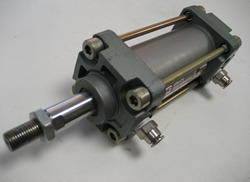
Applications
Pneumatic actuators are used in a wide variety of applications, the most notable being the combustible engine that is used in all conventional automobiles. In a combustible engine, a pneumatic actuator can be observed as the entire system that allows liquid gasoline to be mixed with air and ignited to cause the gas to expand. While this is slightly different than most pneumatic actuators, as most do not include ignition, it works in a very similar manner. Other applications of pneumatic actuators include air compressors, pumps, switches, sensors, pneumatic nail guns, pneumatic mail tubes, and countless industrial purposes.
Advantages
Pneumatic actuators are easy to both produce and control because they are so simplistic. Pneumatic actuators are safer than other means of producing motion because their gases are not likely to catch on fire unless specifically contained and ignited in a manner to do so. As pneumatic actuators only contain compressed gases, the gas can be stored even while no electricity is supplied to the actuator. These properties make pneumatic actuators highly durable and allow them to remain operational for a very long time.

sudeeg
“SUDE team is well aware of the latest developments in modernization and automation with stress on economy, efficiency and quality. The products are Pneumatic Actuators etc.”