Home     Blog

Circuit Simulator

A circuit simulator is a computer program that predicts how electronic circuits work. Circuit designs are first entered through the schematic editor, then the simulation engine solves the complex equations that govern circuit behavior.

Circuit simulators are especially useful for designing integrated circuits that are impractical to prototype using breadboards. The three types of simulator are analogue, digital, and mixed mode.
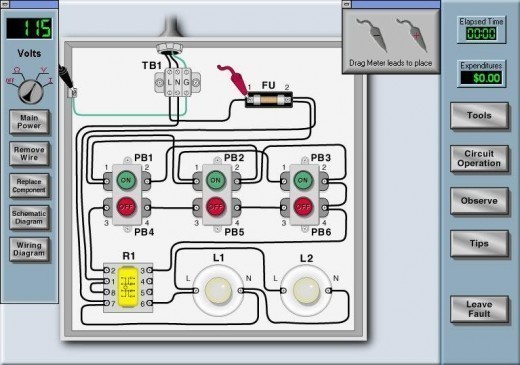
Circuit Simulator Circuit Simulator

Schematic Editor

Early schematic editors were text-based and difficult to use, but modern editors have a graphical interface that allows designers to drag and drop electronic components onto the screen and make connections between them. Sections of circuitry can be saved and imported later, saving many hours of work. Templates of common circuits can also be imported from third party libraries.

Simulation Engine

The simulation engine uses models of circuit behavior and the properties of components to build the equations that describe the circuit's behavior. Approximate solutions for nonlinear differential equations that cannot be solved directly are found by applying numerical methods such as Newton's method. Computer are best suited to this work because of the huge amount of calculation required.

Analogue Simulators

The most widely used analogue simulator is SPICE (Simulation Program with Integrated Circuit Emphasis). It was developed at the University of California, and modified versions are used by most of the circuit manufactures. SPICE was designed for mainframes, but there is also a version for personal computers, called PSPICE.

Digital Simulators

Digital simulators work differently to analogue simulators, by calculating circuit behavior using an event driven method. Verilog and VHDL are two popular digital simulators from which many others have been derived.

Mixed-Mode Simulators

Mixed-mode simulators can solve for both analogue and digital signals in the same circuit by using the event driven model, similar to digital simulators. While they may not be as accurate as a dedicated analogue simulator, they are good enough for most applications.
VN:F [1.9.17_1161]
Rating: 0.0/10 (0 votes cast)
Follow Will.Spencer on

Leave a Reply

Related Posts

  • Integrated Circuit

    An integrated circuit (IC), also called a microchip, is an electronic circuit etched onto a silicon chip. Their main advantages are low cost, low power, high performance, and very small size. History The integrated circuit was invented in 1958 by Jack Kirby (1923-2005), an American engineer. In 2000, he won the Nobel prize in physics [...]...


  • Circuit Breakers

    A circuit breaker is a device that automatically breaks an electrical circuit whenever the circuit becomes overloaded or an unintentional short circuit occurs. Circuit breakers have a set electric current load capacity which when breached results to automatic circuit shutdown. Overloading occurs whenever the wires comprising an electrical circuit are forced to carry and conduct [...]...


  • Filters

    In electronics, a filter is a group of components in a circuit that performs signal processing. They are made from basic components such as resistors, inductors, and capacitors. They also include microprocessors in the case of digital filters. Parts of the input signal may either be blocked or have their frequency and amplitude modified depending [...]...


  • HSCSD (High Speed Circuit Switched Data)

    Fixed/Mobile Mobile Circuit/Packet Circuit Max Bandwidth 57.6Kb Range Coverage area of host network Frequency Frequency of host network Host Network GSM Definer ETSI (European Telecommunications Standards Institute) URL http://www.etsi.org/ HSCSD (High Speed Circuit Switched Data) is a specification for data transfer over GSM networks. HSCSD utilizes up to four 9.6Kb or 14.4Kb time slots, for [...]...


  • Breadboard

    A breadboard is a thin rectangular piece of insulating material used to hold electronic components when making circuit prototypes. They have many rows and columns of conductive points for inserting component terminals and jumper wires. The original breadboards were just wooden boards, presumably used to cut bread on, but the modern versions have plastic cases [...]...