

Hertz is the International System of Units (SI) base unit of measurement for frequency. Hz is the standard abbreviation for hertz. One hertz is defined as “one complete cycle per second,” and can be applied to any periodic event, but is usually applied to sound waves, electrical current, and radio waves. The hertz is the frequency of the cyclical waves in these phenomena.
History of the Hertz
In 1930, the International Electrotechnical Commission (IEC) named the Hertz after Heinrich Hertz, a German physicist. In 1960, it was adopted by the General Conference on Weights and Measures as a replacement to the older “cycles per second.” It can be seen, therefore, that the Hertz is the same thing as its predecessor, only easier to deal with.
Measuring Hertz
Hertz can be measured using a frequency counter, multimeter, or oscilloscope. Some multimeters have basic frequency counters that only work for electrical signals. To measure radio frequency, a proper frequency counter or oscilloscope with RF inputs is required.
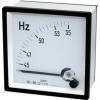
Weak radio signals usually need some amplification and filtering to be measured. This requires the signal to be passed through additional devices before reaching the counter. To measure the frequency of mechanical vibrations, a transducer is required to convert them into electrical signals.
Kilohertz, Megahertz, and Gigahertz
A kilohertz (kHz) is one thousands hertz, a megahertz (MHz) is one million hertz, and a gigahertz is one billion hertz (GHz).
Examples of Hz Measurements
The ticking of a clock is a very simple example of a periodic event measured in hertz. A perfect clock should tick at 1 Hz: one tick per second. Normal residential power in the United States is supplied at 60 hertz, while the frequency of power supplied in Europe is commonly 50 hertz.
Household cordless telephones operate in the megahertz and gigahertz frequencies. Older cordless telephones operated at 900 MHz and below, most using insecure analog signaling. More modern cordless telephones operate at 2.4 GHz and 5.8 GHz. The higher frequencies allow the telephones to be more accurate, more secure, and communicate at further distances from their base units.
Gigahertz is also commonly used to describe the speed of computers’ central processing units (CPU). As a general rule, the higher the CPU’s speed (GHz) the higher the performance of the computer. (In reality, however, the effective power of a computer relies on other measurements besides the speed of the CPU.)
Angular Frequency
To avoid confusion, the standard unit of angular frequency is not hertz but radians per second. A radian is a segment of a circle approximately equal to 57 degrees.
mlnarendea
All your sites are educative for them who r seeking for knowledge.