

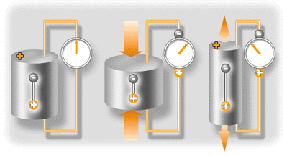
Some materials have the ability to produce electricity when subjected to mechanical stress. This is called the piezoelectric effect. This stress can be caused by hitting or twisting the material just enough to deform its crystal lattice without fracturing it. The effect also works in the opposite way, with the material deforming slightly when a small electric current is applied. Piezoelectricity was discovered more than one hundred years ago and has many applications today. It is used in electronic clocks, gas ovens, inkjet printers, and many other appliances. It is also used in scientific instruments that require extremely precise movements, like microscopes.
History
Pierre Curie and Jacques Curie, two French physicists who were also brothers, first discovered the piezoelectric effect in 1880. Pierre Curie would later share the Nobel prize with his wife, Marie Curie, and Henri Becquerel for their work on radiation. The Curie brothers only discovered that piezoelectric materials can produce electricity, not that electricity can deform them. The next year, Gabriel Lippmann discovered this converse effect. Despite these exciting discoveries, it was not until the early twentieth century that practical devices began to appear. Today, it is known that many materials such as quartz, topaz, cane sugar, Rochelle salt, and bone have this effect.
How the Piezoelectric Effect Works
The piezoelectric effect occurs when the charge balance within a material’s crystal lattice is disturbed. When there is no applied stress on the material, the positive and negative charges are evenly distributed so there is no potential difference. When the lattice is changed slightly, the charge imbalance creates a potential difference, often as high as several thousand volts. However, the current is extremely small and only causes a small electric shock. The converse piezoelectric effect occurs when the electrostatic field that an electrical current creates causes the atoms in the material to move slightly.
Applications
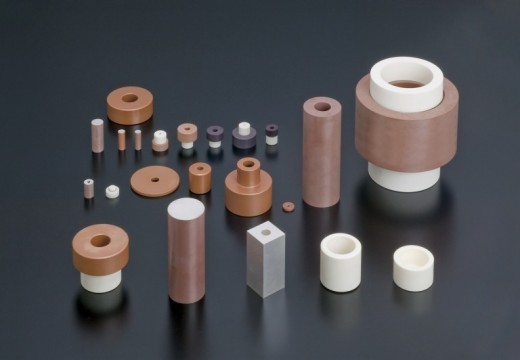
Small piezoelectric crystals can produce enough voltage to create a spark large enough to ignite gas. These igniters are used in many gas-powered appliances like ovens, grillers, room heaters, and hot water heaters. They are even small enough to fit inside lighters, although most lighters still use flint because it costs less and only the more expensive lighters use piezo igniters. While there have been many attempts to generate electricity from the effect, it has proven impractical on a large scale.
Piezoelectric crystals are used in electronic clocks and watches to maintain the time and provide the alarm noise. They are also called quartz clocks because the crystal they use is often made from quartz. It has a natural frequency that is ideal for creating the oscillations needed to maintain exact time. Quartz clocks are also used to organize the flow of data in computers. Discs made of piezoelectric material are also used to create thin speakers that fit inside wristwatches.
Sonar transducers apply an electrical pulse to a piezoelectric crystal to create a pressure wave, then produce a current when the reflected wave deforms the crystal. The time gap between the two currents is used to work out how far away an object it. Industrial inkjet printers use the converse piezoelectric effect to move ink through the hundreds of nozzles in their print heads. An electric current makes a tiny crystal in each nozzle bend, creating a pressure pulse that forces the ink out. Ink is drawn into the nozzle when the current stops and the crystal relaxes.

sadia
why not all crystalls shows the effect of piezoelectricity
vinay krish
All the crystals doesn’t generate electricity because, except piezoelectric materials, the atoms arrangements of all other materials are symmetrical in nature. But the atoms arranged in the piezoelectric materials are not a symmetrical one. Here the atoms are balanced and they also exhibit neutral electric charges in the null deformation.
When the material undergoes deformation all the positive and negative charges are getting displaced which tends to produced electric dipoles.
Aravind Rajkumar
i’m currently working on piezoelectric crystals. may i know if a piezoelectric crystal can give out a constant mechanical output if a DC input is fed?
Thanks in advance.
Ferristown
Great article, thank you. I’ve to research this stuff for a presentation and had no idea where to start. This is far and away the most concise and easily understandable explanation I could find, now I at least know what I’m doing!
Brandon
How much force can a piezoelectric crystal undertake before shattering? And how big would said crystal have to be in order to generate those several thousand volts mentioned?
WillSpencer
The answer to “how much force” depends upon how the device is built.
Small piezoelectric crystals can generate high voltages, but at very low amperage — so the total wattage is still quite small.
Brandon
what do you mean when you say that it depends on how the device is built? How does that effect the strength of said crystal? It would obviously depend on the size and thickness of the crystal, but is that what you meant?
WillSpencer
That, and the casing around the crystal.
knarf
can the surface of automobiles be coated with a plastic so that as the vehicle moves faster it will create surface pressure causing an electric current ?
WillSpencer
In theory, you could create something that turned the force of air pushing against the car into an electric current. Of course, doing this will cause the car to need more fuel to generate the same speed. This system would be unlikely to achieve the efficiency of existing vehicle alternators. The TANSTAAFL rules applies.
poojitha
sir,
does piezoelectric effect produce DC or AC? how much voltage,current and power can be generated if we use it in footstep power generation system?
vishnu.p.s
hi sir
i would like to know that if we applied force countinuosly to the piezo crystal, can it produce electricity countinuosly? and will any damage occur to the crystal?
please reply me as soon as possible
Daniel Memetic
No, the force needs to vary for electricity to be produced.
dlwatib
Why did you give that answer? When force is applied to a piezoelectric material it produces an increase in voltage across the material. If the force is maintained, then so is the higher voltage level, isn’t it? Of course you have to make it part of a complete circuit in order to persuade any current to flow at all, and even then it won’t be much, but still, this seems like a recipe for DC current.
WillSpencer
“If the force is maintained, then so is the higher voltage level, isn’t it?”
Nope. Electrical energy is only produced when the force is initially applied, not continuously as the force is maintained.
Think about it this way: If the energy was produced constantly, you could put a heavy object on a bunch of piezoelectric crystals and create “free energy” forever. You would be breaking the First Law of Thermodynamics.
dlwatib
That’s not what the piezo equation says. It says voltage is directly related to pressure. Voltage, not wattage, and pressure, not momentum or something else transitory. The voltage dipole should remain even after the current dies out.
If I’m able to break the First Law of Thermodynamics using a high resistance voltage dipole, tough for the First Law.
WillSpencer
Best of luck with your free energy machine. Please remember to post an “I told you so” note when you’re a billionaire.
dlwatib
Thanks for the luck, I’ll need it. I do have a method in mind, and no, it won’t break any laws of thermodynamics. It’s a form of energy harvesting, based upon a Tesla patent for harvesting radiant energy.
kedisha
hi,
i would like to find out one question . Can you discuss the piezoelectric efffect in both direction ( forward and reverse ) aid with diagram
Aziz Rahman
Hello
I want to know how much electricity can be produced by piezoelectric effect if I use sugar, quartz and PVDF?
sudheer
hi sir i want to know how much it expands in size? i want 1mm size increment in this polymer when i passed the current if it is possible pls tell me how much thickness of this polymer has to be taken
Pat O'Hara
I recently underwent a sleep study and felt extremely irritated, agitated and had various low grade pain toward the latter period of time of the study–can this be from “electrical” exposure
due to the various electrodes?
Will.Spencer
Pat:
The electrodes are sensors and are completely painless — except for the glue with which they stick them on. The wires might make you uncomfortable, only because they keep you from turning over. It seems more likely that whatever caused you to need a sleep study also caused the symptoms you describe.
Dharmesh Patel
I wanted to know that the concept of piezo-electric can be used underneath the roads to produce electricity .
if it is possible than can you guide me how it is gonna work and also the availabilty of the material . .
please reply me as soon as its possible . .
I will be really thankfull . 🙂
memenode
Yes, and there are some such roads which are already being planned or tested if not built already. There was news about it already in 2008. In simplistic terms the pressure produced by cars on the road squeeze piezoelectric crystals, creating electricity by the piezoelectric effect explained above.