Trickle Charging
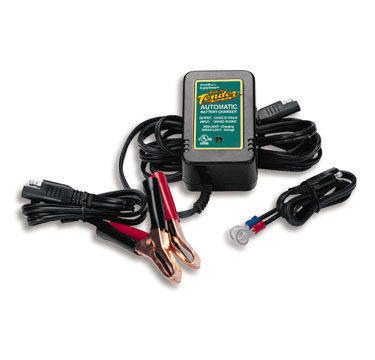
Trickle charging, also called float charging, is the replacement of charge lost through self-discharge. Trickle chargers work at a lower rate than quick chargers, and are used to keep a battery at full charge, not to charge it from empty. Some battery chargers use electronics to control both quick and trickle charge modes, allowing them to change modes once a battery is fully charged.
Self-Discharge
All batteries lose some of their charge over time without any connection between the contacts. The rate of self-discharge depends on the type of battery and other factors such as temperature. For most unused batteries, between twenty and thirty percent of the total charge is lost per month. However, lithium batteries have a self-discharge rate of less than five percent, making them ideal for long term storage.
Charging Differences
Quick chargers operate at a rate of more than one tenth of the battery's capacity, while trickle chargers typically have a rate one hundred times slower. Trickle chargers use a voltage that is just over the battery terminal voltage, lower than the voltage used by quick chargers.
Overcharging
A quick charger should not be used to maintain the battery at fully charge because it would overcharge the battery and cause damage from excess heat. Trickle chargers operate at a rate that doesn't exceed the self-discharge rate, making it difficult to overcharge a battery with one.
Comments (2)
Leave a Reply
- Alternator
An alternator turns mechanical energy into electrical energy, in the form of alternating current. It is a type of generator, most commonly used by automobiles to power their electrical systems. They are usually mounted on the side of the internal combustion engine. How Alternators Work An alternator consists of a rotor, stator, rectifier, housing, and [...]...
- Spark Gap
A spark gap consists of two electrodes separated by a small gap that is filled by a gas, usually air. The potential difference across the gap increases until it reaches the level where the gas ionizes and current flows across it for a brief time. The two types of spark gap are the static and [...]...
- Transformer
A transformer transfers electrical energy between two circuits. It usually consists of two wire coils wrapped around a core. These coils are called primary and secondary windings. Energy is transferred by mutual induction caused by a changing electromagnetic field. If the coils have different number of turns around the core, the voltage induced in the [...]...
- Dielectric
A dielectric is a material that restricts the flow of current. Dielectrics are defined by their dielectric constant, current leakage, and breakdown voltage. They are mainly used in capacitors, allowing charge to build up on the conductive plates. An insulator is a dielectric than can withstand a high electric field without letting current flow through [...]...
- Hall Effect
The Hall effect is the creation of a potential difference perpendicular to both the current flow in a conductor and the magnetic field which pass it. The Hall effect was discovered in 1879 by Edwin Hall, an American physicist. It has many applications such as measuring current and fluid flows. How the Hall Effect Works [...]...


1. How does floating charge work
2. The circuit diagram for the floating charging
Will this help?