HSCSD (High Speed Circuit Switched Data)
| Fixed/Mobile | Mobile |
| Circuit/Packet | Circuit |
| Max Bandwidth | 57.6Kb |
| Range | Coverage area of host network |
| Frequency | Frequency of host network |
| Host Network | GSM |
| Definer | ETSI (European Telecommunications Standards Institute) |
| URL | http://www.etsi.org/ |
HSCSD (High Speed Circuit Switched Data) is a specification for data transfer over GSM networks. HSCSD utilizes up to four 9.6Kb or 14.4Kb time slots, for a total bandwidth of 38.4Kb or 57.6Kb.
14.4Kb time slots are only available on GSM networks that operate at 1,800MHz. 900Mhz GSM networks are limited to 9.6Kb time slots. Therefore, HSCSD is limited to 38.4Kbps on 900Mhz GSM networks. HSCSD can nly achieve 57.6Kbps on 1,800Mhz GSM networks.
The History of HSCSD
HSCSD was an enhancement to to earlier CSD (Circuit Switched Data) standard.
EDGE (Enhanced Data-Rates for GSM Evolution) enabled GSM networks are able to implement ECSD (Enhanced Circuit Switched Data), an enhanced version of HSCSD. ECSD increases the bandwidth of each timeslot to 48Kb and allows the use of eight timeslots, which gives a total transmission speed of 384Kbps.
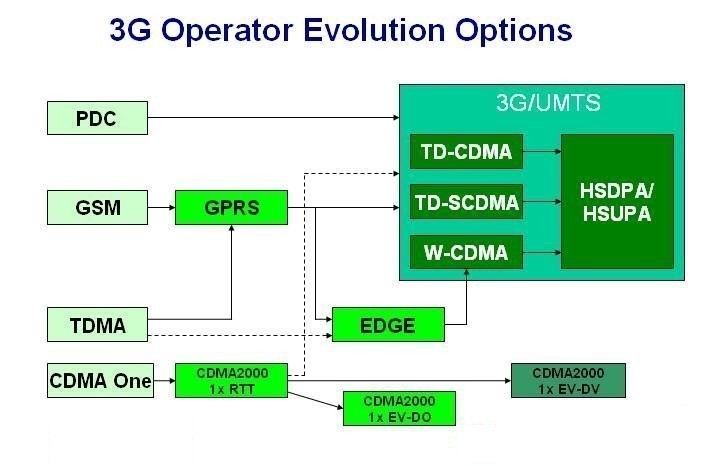
Both HSCSD/ECSD and GPRS are likely to eventually be phased out in favor of UMTS, which is a packet switched technology with speeds up to 2Mbps.
HSCSD vs. GPRS
HSCSD has an advantage over GPRS in that HSCSD supports guaranteed quality of service because of the dedicated circuit-switched communinations channel. This makes HSCSD a better protocol for timing-sensitive applications such as image or video transfer.
GPRS has the advantage over HSCSD for most data transfer because HSCSD, which is circuit-switched, is less bandwidth efficient with expensive wireless links than GPRS, which is packet-switched.
Due to this, HSCSD is not as widespread as GPRS. HSCSD is, however, currently available in over 27 countries.

- EDGE (Enhanced Data for Global Evolution)
Fixed/Mobile Mobile Circuit/Packet Packet/Circuit Max Bandwidth 384Kb Range Coverage area of host network Frequency Frequency of host network Host Network GSM Definer ETSI (European Telecommunications Standards Institute) URL http://www.etsi.org/ EDGE (Enhanced Data rate for GSM Evolution) is a specification for data transfer on GSM networks. EDGE features both a packet capability, EGPRS (Enhanced General Packet [...]...
- GPRS (General Packet Radio Service)
GPRS (General Packet Radio Service) is a specification for data transfer on TDMA and GSM networks. GPRS utilizes up to eight 9.05Kb or 13.4Kb TDMA timeslots, for a total bandwidth of 72.4Kb or 107.2Kb. GPRS supports both TCP/IP and X.25 communications. Fixed/Mobile Mobile Circuit/Packet Packet Max Bandwidth 107.2Kb Range Coverage area of host network Frequency [...]...
- Circuit Breakers
A circuit breaker is a device that automatically breaks an electrical circuit whenever the circuit becomes overloaded or an unintentional short circuit occurs. Circuit breakers have a set electric current load capacity which when breached results to automatic circuit shutdown. Overloading occurs whenever the wires comprising an electrical circuit are forced to carry and conduct [...]...
- Wireless Networks and their Types
Wireless networks are those computer networks that use electromagnetic waves instead of wires in order to carry signals over the various parts of the network. Wireless networks which run over other wireless networks often utilize the lower layer networks to provide security and encryption. Stand-alone wireless networks either provide their own security and encryption features [...]...
- EVDO (EVolution-Data Optimized)
EVDO is an acronym for "Evolution Data Only" or "Evolution Data Optimized" which is a standard for high speed wireless networks used for Broadband Internet connectivity. EVDO enables computer users to have high speed Internet access without the help of a hotspot. Just by inserting an EVDO card into the computer, users get connected to [...]...