

WCDMA (Wideband Code Division Multiple Access) is the radio access scheme used for third generation cellular systems that are being rolled out in various parts of the globe. The 3G systems support wide band services like high speed Internet access and video and high quality image transmission with the same quality as the fixed networks. In WCDMA systems, the CDMA air interface is combined with GSM based networks. The WCDMA standard evolved through the Third Generation Partnership Project (3GPP), which aims to ensure interoperability between different 3G networks.
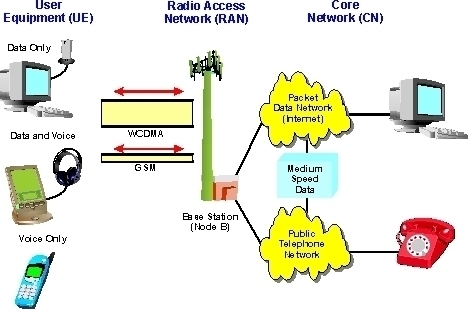
The standard that has emerged through this partnership project is based on ETSI’s Universal Mobile Telecommunication System (UMTS) and is commonly known as UMTS Terrestrial Radio Access (UTRA). The access scheme for UTRA is Direct Sequence Code Division Multiple Access (DS-CDMA). The information is spread over a band of approximately 5 MHz. This wide bandwidth has given rise to the name Wideband CDMA or WCDMA.
In WCDMA, there are two different modes of operation possible:
- TDD: In this duplex method, uplink and downlink transmissions are carried over the same frequency band by using synchronized time intervals. Thus, time slots in a physical channel are divided into transmission and reception.
- FDD: The uplink and downlink transmissions employ two separate frequency bands for this duplex method. A pair of frequency bands with specified separation is assigned for a connection. Since different regions have different frequency allocation schemes, the capability to operate in either FDD or TDD mode allows for efficient utilization of the available spectrum.
Key Features of WCDMA
The key operational features of the WCDMA radio interface are listed below:
- Supports high data rate transmission: 384 Kbps with wide area coverage, 2 Mbps with local coverage.
- High service flexibility: supports multiple parallel variable rate services on each connection.
- Both Frequency Division Duplex (FDD) and Time Division Duplex (TDD).
- Built in support for future capacity and coverage enhancing technologies like adaptive antennas, advanced receiver structures, and transmitter diversity.
- Supports inter frequency hand over and hand over to other systems, including hand over to GSM.
- Efficient packet access.
WCDMA Technical Specifications
| Multiple Access Scheme | DS-CDMA |
| Duplex Scheme | FDD/TDD |
| Packet Access Dual mode | (Combined and dedicated channel) |
| Multirate/Variable rate scheme | Variable spreading factor and multi-code |
| Chip Rate | 3.84 Mcps |
| Carrier Spacing | 4.4-5.2 MHz (200 kHz carrier raster) |
| Frame Length | 4.4-5.2 MHz (200 kHz carrier raster) |
| Inter Base Station synchronization | FDD: No synchronization neededTDD: Synchronization required |
The chip rate may be extended to two or three times the standard 3.84 Mcps to accommodate data rates higher than 2 Mbps. The 200 kHz carrier raster has been chosen to facilitate coexistence and interoperability with GSM.
sasikumar
what mens wcdma slot… gsm or cdma sim
kido
May I know if it is possible to make phone calls on external 3G dongles w/ WCDMA support to Android Mid Tablets? I don’t have any unit yet and still planning to buy for a model of this type of specs. Thanks!
sbv4u2@gmail.com
I would like to know if I can use cell phones of WCDMA for my CDMA sim card from Reliance Mobile or Tata Indicom. Can some one answer this, please?
kail01
can i use 2G or 3G GSM sim card in WCDMA slot mobile?
Achuthan
Hi,
i want to know whether its possible to transfer image file using w-cdma in multihop cellular networks or its not possible??
plse do reply for this post….this is needed for my project work.
memenode
I don’t see why it wouldn’t be possible. Internet is a mesh, multihop network.
Kimberly
Hi, I was planning to upgrade my cell phone and my carrier is Metropcs, in the states. I was wondering if this phone would operate on the CDMA platform. The “W” is new to me. Please help me understand.
Thanks in advance,
Kimberle
memenode
What is your phone? You can check if it’s a CDMA phone, and if it is then yes… WCDMA just seems to be UMTS, for 3G mobile internet access.
bg
u need to look for articles and do a research, read the future works and then choose one of the topics and do that as ur project.
awaisqazi
i want to make project on wcdma modes of operation…….plz tell mewhat i should do