

Specific gravity is a special case of relative density. That is, a substance’s density is divided by the density of water at 4 F (0 C). Since water has a density of 1 gram/cm3 and all of the units cancel, specific gravity is the same number as density, but without any units (dimensionless).
Relative density is another dimensionless number that measures any substance’s density in relation to another. A relative density greater than 1 (one) means that the substance in the numerator has a bigger density than the one in the denominator and vice versa.
When the same concept is applied to specific gravity, if the substance is not miscible with water (does not mix or dissolve) it will float if its specific density is more than 1 (one) and will sink if the specific gravity is less than 1 (one).
Density is the ratio between mass and volume. It reveals interesting information about a substance and affects the way atoms and molecules in a substance are arranged. Atom and molecule arrangement depend on temperature among other things.
How to Determine Specific Gravity
Liquids: A liquid’s specific gravity can be determined with a hydrometer. The depth to which the hydrometer sinks is inversely proportional to the liquid’s specific gravity. A hydrometer is a hollow, sealed, calibrated glass tube.
Solids: Some electronic scales can measure a solid’s specific gravity. This is particularly useful for determining a gem’s purity.
Gases: Specific gravity transducers measure a gas’s specific gravity. They are particularly useful to power, oil, gas, aerospace, and process industries.
Practical Specific Gravity Uses
Specific gravity measurements can be used in a wide variety of industries. It is particularly useful because it allows access to molecular information in a non-invasive way.
Gem Purity: The purity of a gem can be determined by comparing its specific gravity with the patron number (measured over a gem with high purity level). This allows the gem’s value to be determined very quickly.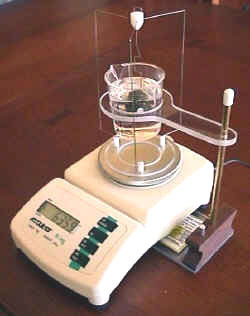
Eggshell thickness: Eggshell thickness is an important factor in the poultry industry. It decays with the age of the hen or under adverse conditions. If the thickness falls below certain expected values, the eggs are not marketable. The eggshell mainly determines an egg’s specific gravity, while the other components have specific gravity close to 1 (one) (shell= 2.325; yolk= 1.032; albumen= 1.038; shell membranes= 1.075). One can gain a good idea of the shell’s state by measuring the whole egg’s specific gravity.
Soil’s Compressive strength: Engineers need to know a soil’s compressive strength to choose a construction method (among other things). Specific gravity and compressibility are highly connected and can be obtained one from the other.
Oil Industry: Crude oil and its refined products are normally measured either by volume in gallons and US barrels or by weight in tons. Specific gravity or density can measure the relationship between volume and weight. The specific gravity is related with the ‘degree API,’ a measurement of the oil’s inherent power (regular, super, etc.).
Table of Specific Gravities Used in the Oil Industry
| Product | Specific Gravity Ranges |
|---|---|
| Crude oils | 0.80-0.97 |
| Aviation gasolines | 0.70-0.78 |
| Motor gasolines | 0.71-0.79 |
| Kerosines | 0.78-0.84 |
| Gas oils | 0.82-0.90 |
| Diesel oils | 0.82-0.92 |
| Lubricating oils | 0.85-0.95 |
| Fuel oils | 0.92-0.99 |
| Asphaltic bitumens | 1.00-1.10 |
Tim
Does any one know if there is a table or a conversion for specific gravities for oil with high percentages of water? 20,30,40% ranges or higher. I saw a table from Tide Water from 1966 but no reference from where it came from or if it was even API. Thanks
layan
what the uses of specific gravity in medicine?
Abdul
Specific Gravity is mostly detected in urine liquid. It is based on the response of a polymeric acid to surrounding ions.
Ahmad Salah
” if the substance is not miscible with water (does not mix or dissolve) it will float if its specific density is more than 1 (one) and will sink if the specific gravity is less than 1 (one).”
I think the reverse is true or plz explain.
Thanks in advance
Lummo
You are absolutely right. The article is wrong. If the SG of a liquid is less than one then a certain volume of the liquid will weigh less than the same volume of water and, thus, it will float on the water. Think about mercury with an SG of 13.6. That’s more than one yet the mercury clearly sinks in water or, to put it the other way around, the water floats on the mercury!
irwansyah
How to measure the SG for gasoline and HSD? How many sample should be taken for the test? what size of glass should be used? ta
Hani
it depends on the ASTM method and equipment
Vijay
What material floats in water but sinks in diesel ?
jerry couturier
ok so i weigh a item its 104.3 grams
i hang it on a string and weigh it in water its 12.6 whats the specific on that?
lauren
hi im awesomely pretyyand peppy im awesome and im doing a science expo on this why do things float better in salt water rather than frsh my dad says i shoud look this up .is that cruel
memenode
Salt water is more dense because of salt dissolved in it which makes its mass bigger so things can float in it better.
Scottie
You sound awesomely dumb too!
Ernest Stabilow
can i please no the theory behind specific gravity and density in determining tonnage factor as used in ore reserve estimation.
Greg Weis
if the substance is not miscible with water (do not mix or dissolve) it will float for specific density over one and will sink for specific gravity under one.
Is this a typo? I seem to be confused.