

Electromagnets are magnets whose magnetic properties come from or are generated through electricity. A magnet is a material (this is usually metal), which has at least one pair of negative and positive poles. These opposite poles' attraction produces a magnetic field. This gives the magnet the ability to 'attract' metals such as iron or steel.
Electromagnets are soft magnets whose magnetic field can be strengthened or weakened depending on the electric current applied; the stronger the current, the stronger the magnetic field produced. Electromagnets are distinct from hard magnets (manufactured or naturally occurring). The magnetic field of hard magnets is quite permanent or long lasting and is therefore not dependent on electric current.
The Concept and Basic Design
The passage of electric charge (electrons) from a battery's or power source's negative terminal through wires generates a weak magnetic field. This magnetic field is so weak (or so small) that it is generally undetected. However, a compass will detect such a magnetic field.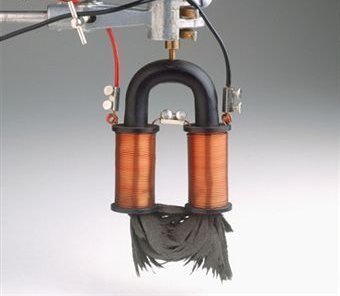
To be useful, therefore, the magnetic field generated through the flow of electrons should be strengthened. This can be done by making a tight coil of conductive wire. The coils will reinforce and strengthen the magnetic field which has a direction or orientation that is perpendicular to the direction of the electric current.
When electricity is supplied to this coiled wire, there will result various magnetic domains for each coil. These magnetic domains will tend to align themselves; and the stronger the electric current applied, the more the individual magnetic domains will be aligned. The application of an optimal level of electric current will result in a perfect alignment of all magnetic domains – and result in optimal magnetic strength.
To make the electromagnet even more powerful, one can coil the wire around a material that has magnetic permeability or susceptibility (simply, a material that can be magnetized). The core material can be something that is capable of being temporarily magnetized such as paramagnets which are susceptible to magnetism but are unable to retain their magnetic properties after the application of the electric current stops. The core material can also be ferromagnets which are capable of retaining the magnetic field they have acquired even after electric current application ceases.
In any case, the inclusion of a core magnetic material in an electromagnet strengthens magnetic field output.
Advantages and Uses of Electromagnets
Electromagnets' main advantage springs from their versatility and flexibility. In an electromagnet, the magnetic field can be turned on and off. This is especially useful for cargo loading applications; cargo can be picked up using an electromagnet, the cargo carried to its ideal location, then easily released by turning off the electricity supply. The magnetic field's strength can also be varied by changing the amount of electric current applied.
The variability of their magnetic field makes electromagnets ideal for applications where magnetic strength requirements frequently change. For instance, electromagnets are used in circuit breakers where an electromagnet 'pulls' open a circuit only if electric current load is approaching dangerous levels.


Rose 13
this site helped me alot becasue i makeing a electromagnet thanks a bunch