

This is the “right hand” of both the professional and the amateur lineman. Basically, it is a customized portable telephone which is designed to be hooked onto raw cable terminals in the field and used to monitor the line, talk, or dial out. The monitor function is usually the main difference between the “butt-in” test set and the normal phone.
If you don’t have a real test set already, the following circuit can convert a normal $4 made-in-taiwan phone into a working test set. The “all-in-one” handset units without bases are the best (I tend to like QUIK’s and GTE Flip Phone II’s). Anyway-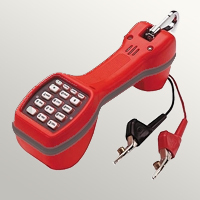
OFFICIAL Agent 04 Generic Test Set Modification (tm)

  Ring >---------------------------------> to "test set" phone
   Tip >------!  SPST Switch    !-------->
              !-----/ ----------!
>from         !-------/!/!/!/!--!    C = 0.22 uF  200 WVDC Mylar
cable pair    !   C       R     !    R = 10 kOhm 1/2 W
(alligators)  !--! (------------! SPST = Talk / Monitor
When SPST is closed, you are in talk mode; when you lift the switch-hook on the “test set” phone, you will get a dial tone as if you were a standard extension of the line you are on. You will be able to dial out and receive calls. When the SPST is opened, the resistor and capacitor are no longer shunted, and they become part of the telephone circuit.
When you lift the switchhook on the test set, you will not receive dial tone, due to the fact that the cap blocks DC, and the resistor passes less than 4 mA nominally (far below the amount necessary to saturate the supervisory ferrod on ESS or close the line relay on any other switch).
However, you will be able to silently monitor all audio on the line. The cap reactance + the phone’s impedance insure that you won’t cut the signal too much on the phone line, which might cause a noticeable change (..expedite the shock force, SOMEONE’S ON MY LINE!!). It’s also good to have a VOM handy when working outside to rapidly check for active lines or supervision states.
This FAQ answer was written by Phucked Agent 04
Follow Us!