

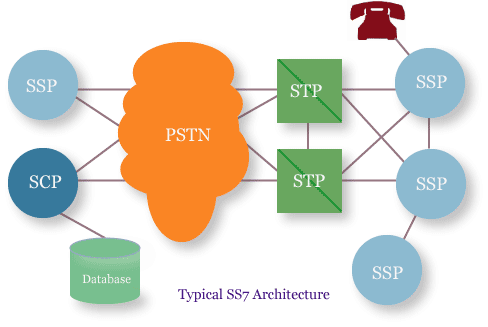
SS7 (Signaling System 7) is a standard for control signaling in the PSTN (Public Switched Telephone Network.
SS7 signaling is done out-of-band, meaning that SS7 signaling messages are transported over a separate data connection. This represents a significant security improvement over earlier systems which used in-band signaling.
The first CCS protocol was the Signaling System 6, defined by the ITU-T in 1977. SS 7 replaced the SS6 in 1980. SS6 had certain limitations, since its signal wasn’t amendable to digital systems. Both SS6 and SS7 are called CCS (Common Channel Signaling) or CCIS Systems (Common Channel Interoffice Signaling Systems) because of the hard separation of signaling. With common channel signaling, exchanging signaling without seizing a facility first, has become possible. This has led to significant increase in performance and it has also reduced costs.
Signaling methods used before SS 7 did not have the capacity to communicate much signaling data. SS 7 can communicate great amounts of information during the call, which allows development of various call-related services. Call forwarding, call waiting, voice mail, number display, malicious caller ID, and call screening are some of these services.
SS 7 operates in 2 modes: quasi-associated and associated. The second one is less expensive for small networks, but it is not predominant in theUS. The quasi-associated mode is mostly used by large networks and it’s predominant in theUS.
SS7 is referred to by many other names, including CCS7 (Common Channel Signaling System 7), C7, Number 7, and CCIS7 (Common Channel Interoffice Signaling 7).
SS7 Tutorials
To learn more about SS7, explore one of these fine SS7 tutorials:
SS7 Specifications
The official specifications for SS7 are available from the ITU-T in the Q.7xx series recommendations.
ITU-T Q.7xx Series RecommendationsDocumentNumber Description
| Q.700 | Introduction to CCITT Signalling System No. 7 |
| Q.701 | Functional description of the message transfer part (MTP) of Signalling System No. 7 |
| Q.702 | Signalling data link |
| Q.703 | Signalling link |
| Q.704 | Signalling network functions and messages |
| Q.705 | Signalling network structure |
| Q.706 | Message transfer part signaling performance |
| Q.707 | Testing and maintenance |
| Q.708 | Assignment procedures for international signaling point codes |
| Q.709 | Hypothetical signaling reference connection |
| Q.710 | Simplified MTP for small systems |
| Q.711 | Functional description of the Signalling Connection Control Part |
| Q.712 | Definition and function of signaling connection control part messages |
| Q.713 | Signalling connection control part formats and codes |
| Q.714 | Signalling connection control part procedures |
| Q.715 | Signalling connection control part user guide |
| Q.716 | Signalling connection control part performance |


Follow Us!