What is SS7?

SS7 (Signaling System 7) is a standard for control signaling in the PSTN (Public Switched Telephone Network.

SS7 signaling is done out-of-band, meaning that SS7 signaling messages are transported over a separate data connection. This represents a significant security improvement over earlier systems which used in-band signaling.

SS7 is referred to by many other names, including CCS7 (Common Channel Signaling System 7), C7, Number 7, and CCIS7 (Common Channel Interoffice Signaling 7).
SS7 Tutorials

To learn more about SS7, explore one of these fine SS7 tutorials:

SS7 Specifications

The official specifications for SS7 are available from the ITU-T in the Q.7xx series recommendations.

ITU-T Q.7xx Series Recommendations
Document
Number
Description
Q.700Introduction to CCITT Signalling System No. 7
Q.701Functional description of the message transfer part (MTP) of Signalling System No. 7
Q.702Signalling data link
Q.703Signalling link
Q.704Signalling network functions and messages
Q.705Signalling network structure
Q.706Message transfer part signaling performance
Q.707Testing and maintenance
Q.708Assignment procedures for international signaling point codes
Q.709Hypothetical signaling reference connection
Q.710Simplified MTP for small systems
Q.711Functional description of the Signalling Connection Control Part
Q.712Definition and function of signaling connection control part messages
Q.713Signalling connection control part formats and codes
Q.714Signalling connection control part procedures
Q.715Signalling connection control part user guide
Q.716Signalling connection control part performance

Books on SS7

Signaling System No. 7 (SS7/C7): Protocol, Architecture, and Services
A complete, practical guide to the world's most popular signaling system, including SIGTRAN, GSM-MAP, and Intelligent Networks.
  • Provides in-depth coverage of the SS7 protocols, including implementation details
  • Covers SS7 over IP (SIGTRAN) using real-world examples
  • Covers SS7/C7 from both a North American and European perspective, providing a broad international understanding of the technology and associated standards
  • Explains mobile wireless concepts and signaling, including mobile application part (MAP)
  • Provides a thorough explanation of the Intelligent Network (IN) and associated protocols (INAP/AIN)

Signaling System No. 7 (SS7) is a signaling network and protocol that is used globally to bring telecommunications networks, both fixed-line and cellular, to life. SS7 has numerous applications and is at the very heart of telecommunications. Setting up phone calls, providing cellular roaming and messaging, and supplying converged voice and data services are only a few of the ways that SS7 is used in the communications network. SS7 also provides the point of interconnection between converging voice and data networks. This transition, which affects everyone who works with the data network, has bolstered the need for practical and applied information on SS7. In short, anyone who is interested in telecommunications should have a solid understanding of SS7.

Signaling System No. 7 (SS7/C7): Protocol, Architecture, and Services will help you understand SS7 from several perspectives. It examines the framework and architecture of SS7, as well as how it is used to provide today's telecommunications services. It also examines each level of the SS7 protocol-all the way down to the bit level of messages. In addition, the SIGTRAN standards are discussed in detail, showing the migration from SS7 to IP and explaining how SS7 information is transported over IP.

Signaling System #7
Signaling System #7
Offers a reference for anyone working with Signalling System 7 (SS7). Contains a complete short course on SS7 architecture and protocols, technical data for design and specifications, and analysis of key specifications. Each chapter provides a three-step approach to learning, with overviews, detailed discussions, and bit-level descriptions. This edition is updated to reflect the latest changes in the SS7 signaling network and its cellular, broadband, and international applications.
Signaling System 7 (SS7) Basics

This introductory book explains the operation of the signaling system 7 (SS7) system and how it controls and interacts with public telephone networks and VoIP systems. SS7 is the standard communication system that is used to control public telephone networks. In addition to voice control, SS7 technology now offers advanced intelligent network features and it has recently been updated to include broadband control capabilities, local number portability, and mobile communication services. SS7 networks are now interconnecting with and operating on Internet data networks.

This book will help the reader gain an understanding of SS7 technology, network equipment, and overall operation. It covers the reasons why SS7 exists and is necessary, as well as step-by-step procedures that describe the actions that occur in the network. SS7 Basics, 3rd Edition is for the technical and the non-technical reader alike.

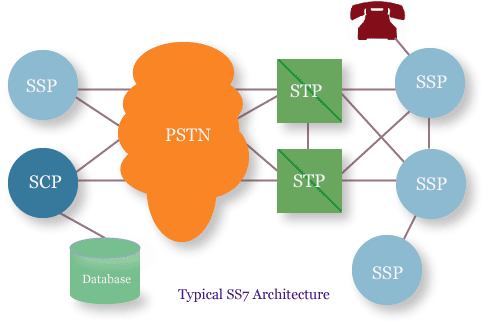
  • SS7 network architecture including SSP, SCP, and STP operations.
  • Call processing control (ISUP) and broadband telephony applications (BISUP).
  • Mobile application part (MAP) for communication with wireless systems..
  • Transaction capabilities part (TCAP).
  • Operations, Maintenance and Administration (OMAP).
  • SS7 interaction with voice over data networks including SIP, MGCP, MEGACO and H.323.
  • Transporting SS7 messages over IP networks using SIGTRAN and SCTP.
  • Number portability including local portability (LNP), service portability, and geographic portability.
  • Intelligent Network (IN) and SS7.
  • International SS7 systems.


Bookmark What is SS7?

Free White Papers on Telephony


Telephony Magazine

Latest Blog Posts


English English GermanGerman SpanishSpanish FrenchFrench ItalianItalian PortuguesePortuguese RussianRussian DutchDutch
GreekGreek HindiHindi JapaneseJapanese KoreanKorean ChineseChinese Chinese (Simplified)Chinese (Simplified) ArabicArabic

Copyright 2009 Tech-FAQ. All rights reserved. Privacy Policy.