

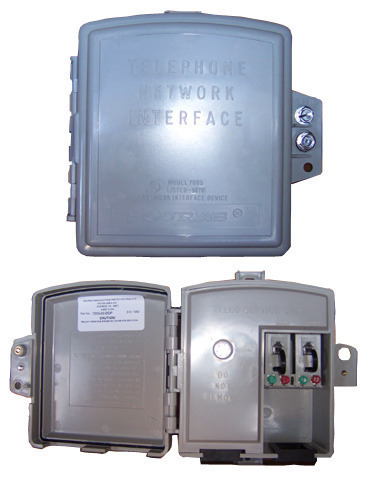
The telephone Network Interface Device (NID) is what connects your home telephone lines to the telephone company’s network. It is usually a small gray box located on the exterior of your home. It usually contains a modular phone plug that you can use for testing the line. They need both inside testing and outside testing. In some older installations, you may not have a NID. Instead, you will find a “protector block”, a small plastic covered box where the cable coming out of your house connects to the phone company’s cable leaving your house. The protector block serves the same purpose as the NID, but does not provide a modular jack where you can check if you are getting dial tone from the phone company.
Inside Testing
Plug a corded telephone into each of your phone jacks. Check for dial tone or static. Repeat process using a different corded telephone to make sure the first phone is not the cause of the problem. Remove the plug from each jack in the NID. Plug in a working, corded phone. If you hear a dial tone, make a test call. If your call goes through, the problem is inside your home. This is where having a service on your phone plan called a ‘inside wire maintenance plan’ is beneficial! It is usually only a few dollars a month, and if there is a problem with the inside wiring, the phone company will fix it for free. Otherwise, you will have to pay for the service call!
Outside Testing
Each telephone number in your home should have a jack with a dial tone in the NID. If there is no dial tone or static on the line, the problem is likely in the line outside your home. Now repeat this step with a different phone. That way you can make sure that the first phone is not the cause of the problem. By taking a corded phone to the NID on the outside of your home, and testing your phone from the phone jack in that box, you will be able to tell the phone company if the problem is inside or outside the home. If you do not get a dial tone when using the outside NID box, then the problem lies in the phone company wiring somewhere.
To use ADSL or other high speed Internet you need to have an up-to-date NID. It is possible that you will need a new Network Interface Device if you happen to have an older one. Apartments and office buildings should have up-to-date NIDs. Older residences are most likely the ones that will need this free upgrade.


Diane
A few years back we had like a..explosion in my house, while I was in the house…… and we tracked it to the out side interface server telephone/antennae box… It buzzed our line, started a small fire on the inner wall..blew up the phone and melted all the line..no house fire ..but if I wasn’t there it might have burnt our home down… ..And it was not from lighting and then few days later ….a neighbor was using a hand held explosive tiny device blowing up home made tiny explosives and man those suckers would make the loudest noise and this made me wonder about what happened at our home…The telephone company said they never ever saw anything like this and lighting could never do that! they recorded the situation I have it all on photos so if this ever happens again and if we have something similar in the neighborhood again!
All I can say is the Telephone companies better put locks on those boxes and they only have permission to go into them for work or you have to get a permits if you want to do something with one with the outside inlet interface box!! Cause that scared the freaking hell out of me have a phone fly at you from something possible not by lighting other words mother nature natural causes!!
Colleen D. Wood
I’d like the interface box removed from the outside of house, due to construction. Called my Optimum Cable and Verizon was told they don’t handle this. All the wires are cut inside the box on the consumer side, I can’t open the other side due to the lock/screw. Do you know who to contact to remove said box. Or can I hire an electrician to do this form me. House is located in Bridgeport, CT.06604
Ric Moxley
question — can i not simply use the test jack in telephone NID to run a line into my home? I’m a consumer that has a very simple need — just a line from the NID through the floor and to my DSL modem. If i can use the test jack to do this, then i don’t have to hire out the work or learn how to work with the wires — i just buy a long phone extension wire with the jacks already on each end, and I’m done! …. yes, or no? thanks…. 🙂
Shawn
i have been tasked with getting phone service from our old church building to our new church building which is all on the same property and all right next to each other. We don’t want a new telephone number but instead want to come off the old church buildings NID to the new NID for a bunch of reasons. I need to know exactly what I need and where I can get it. I have already installed the phone line and need to know how to connect it all. I’ve been asked to do this because I’m the electrician and I’m not totally ignorant just nned some education on phone hook ups
duncan
I used to have two phone lines (2 phone numbers) to my house. I had the second one disconnected.
The second line went straight from the NID to a phone jack in my den. Since the 2nd line was disconnected, the phone jack in my den became useless. Now, I want to connect that phone jack in my den to my current existing phone line.
I noticed that in the NID, the module for the 2nd line is next to the module for the 1st (current, now in use) line. The wire that ran from my phone jack in my den is still connected to the 2nd line module in the NID.
Is it possible to unscrew the wires in the 2nd line module, stretch the wires over to the 1st line module, and then screw them (yellow one to green screw and black one to the red screw) of the 1st line module?
There are two green and two red screws in the 1st line module. One of the green screws and one of the red screws already have a green and red wire connected to them (for the current phone line). The other green and red screws are unoccupied.
I hope my description isn’t too confusing. Thank you for your help.
Martha Montano
With one of these boxes, can the phone line be tapped by law enforcement at the Phone company or outside the residential property where one of these are connected? AT & T took it upon themselves to connect it withOUT my permission or telephone trouble ticket call.
Benny
No. Originally, the Supreme Court ruled in 1928 (Olmstead v US) that phone lines could be wiretapped outside the home because those areas weren’t private places. However, in 1967 the Supreme Court overruled this decision, stating that warrants are needed for wiretapping phone lines regardless of the physical location of the phone line to be tapped, because phone users have a reasonable expectation of privacy about their phone conversations. (Katz v US, 1967)
Nate
so the answer is actually “yes!”
AT&T can tap your line with a warrent and without [your] permission or telephone trouble ticket call.
How many of those engaged in criminal activity would either give permission or take the extra step of requesting a trouble ticket to obtain a law enforcement tap?
It would be easier just to conference them in….
Nate
…. actually, I think it’s a legal requirement for all telecom providers to provide law enforcement access to an individual’s communication channels when such access is warranted. This has nothing to do with whether you have a NID or not, and applies to cell calls, too.
ae4qp
where can I purchase the two lightning protectors for my Telephone Network Interface Device?
Leo Guaydacan
Can I add a third line to an Telephone Network Interface Device? If yes, is the wiring the same at the location where the phone line connects to the telephone company?
memenode
I’m no expert, but I don’t think so, if I understand your question correctly. You should probably contact your phone company if you’d like an extra line.
cheryl
no..if u want to add another phone line, u should have another Network Interface Device..^^,
Will.Spencer
Most NID’s are pre-wired to support a second phone line. The first telephone line comes over the red and green wires and the second over the yellow and black wires.
Bruce DeLauder
Where can I purchase a telephone network interface device to install myself without having to call a serviceman?
memenode
Try Google Shopping.
Rex Cossey
I saw NID’s for sale on ebay